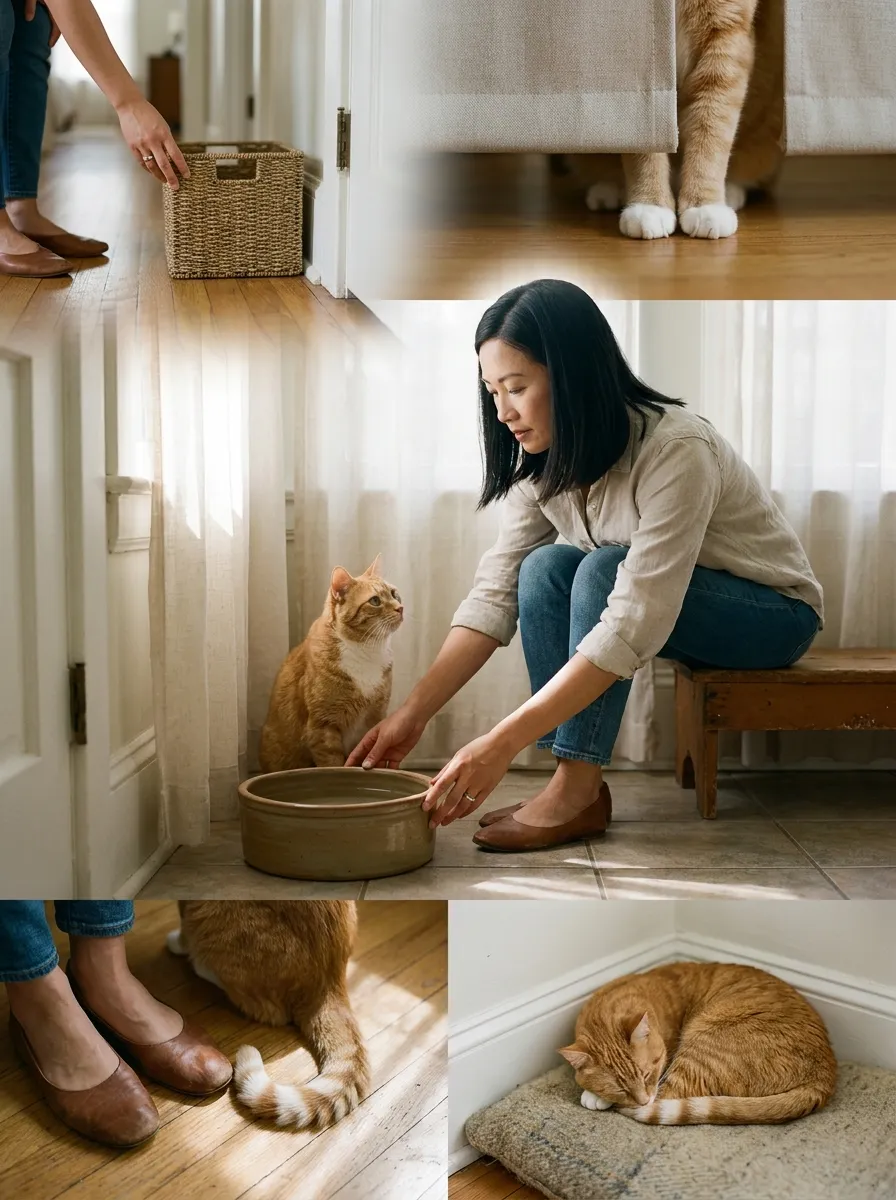
When the Room Slowly Rearranges Itself Around Another Life
September 26, 2026 • 5 min read
A room rarely announces that it has changed. The furniture may still be familiar.
The same door opens into it. The same light reaches the floor.
The same objects remain where they have been for years. And yet the room may no longer be organized around only one life. Something has moved.
Perhaps not dramatically. A pathway has been left clearer. One corner has acquired a different purpose.
An object now sits somewhere else because another presence repeatedly moves through the space. A place that once seemed available has gradually become difficult to think of as empty. None of these changes necessarily arrives as a decision about the relationship.
They may begin as practical adjustments. Something needs room. Something works better somewhere else.
A repeated movement makes one arrangement less natural than another. So the space changes. Then the new arrangement becomes ordinary.
That is what makes accepting the physical reorganization of living spaces to accommodate another life’s natural rhythms more interesting than simply moving things around. The physical change is visible. What produced the willingness to keep changing may be harder to see.
A home contains habits before it contains explanations. People learn where to place things. Which routes they take through rooms.
Which surfaces remain clear. Which corners are useful. Where quiet usually gathers.
Much of this eventually happens without thought. Then another life becomes part of the same space. The room is no longer encountered by one set of movements alone.
Another rhythm enters. Another body occupies distance differently. Another presence repeatedly appears in certain places at certain moments.
Gradually, the existing arrangement may stop feeling entirely sufficient. Not wrong. Simply incomplete.
Perhaps the first adjustment feels temporary. Then another follows. And eventually it can become difficult to remember exactly when the room began accommodating more than its original design.
That shift can be subtle because accommodation rarely looks dramatic from inside ordinary life. A person does not necessarily wake up and decide to reorganize a home around companionship. More often, attention accumulates.
You notice where movement happens. You notice what is repeatedly in the way. You notice which places seem to remain part of another life’s ordinary rhythm.
You begin accounting for those things. The relationship becomes an education in awareness. That education does not have to arrive as instruction.
Nothing needs to teach a lesson deliberately. The room itself begins making certain patterns visible. A route that seemed irrelevant becomes something you remember.
A corner becomes something you avoid disturbing without having formally declared it protected. The location of an object starts depending on more than where it looks best or where it once seemed convenient. Another life has become part of the calculation.
Perhaps calculation is too deliberate a word. Much of it may happen before calculation. The body adjusts.
The hand places something differently. A pathway remains open because closing it no longer feels natural. What began as conscious accommodation becomes ordinary movement.
And once that happens, the room carries evidence of the relationship without displaying anything that looks especially meaningful. There may be no symbol. No sentimental object.
No obvious marker of affection. Only space arranged differently than it would have been otherwise. That difference can be easy to overlook because homes are always changing.
Objects move. Needs change. Rooms acquire new functions.
Nothing about physical reorganization automatically tells us why it happened or what it means. The temptation would be to make every accommodation proof of devotion. But the reality can remain less polished.
Sometimes an adjustment is simply necessary. Sometimes it is mildly inconvenient. Sometimes the new arrangement is less aesthetically satisfying or less efficient for the human part of the household.
Acceptance does not require pretending otherwise. Perhaps that is part of what gives the reorganization its relational weight. Another life does not fit into a home only where there is leftover room.
Shared life can ask the existing space to become negotiable. Not endlessly. Not without boundaries.
But enough that the original arrangement stops being treated as untouchable. The home begins reflecting coexistence rather than addition. There is a difference between adding another presence to a room and allowing that presence to affect what the room becomes.
Addition leaves the original structure unquestioned. Accommodation permits response. Something moves because something has been noticed.
Something remains because repetition has made it recognizable. Space begins recording attention. Not perfectly.
Not permanently. But visibly enough that the household would not look exactly the same without the life now living inside it. That thought can be surprisingly difficult to separate from the physical details.
A room seems material. Walls. Floor.
Furniture. Objects. Distances.
But shared space is also made of pathways and permissions. Where bodies can move. Where they tend to rest.
Where activity gathers. Where one presence makes room for another. These things may never be written down, yet the physical environment can begin reflecting them.
The room learns, in a sense, by being rearranged. Not because rooms possess awareness. Because the people inside them do.
Attention changes placement. Placement changes movement. Movement creates new habits.
Then the habits become so ordinary that the room seems as though it had always been this way. That may be one of the quieter signs of adaptation. What once felt like accommodation eventually stops feeling separate from home.
The changed arrangement becomes simply the arrangement. The route around something becomes simply the route. The protected corner becomes simply that corner.
The object moved elsewhere no longer seems misplaced. Ordinary life closes over the history of those changes. And perhaps that is why physical space can reveal something about companionship that language easily misses.
It shows what attention has been willing to alter. Not what someone claims to value. Not what someone intends to feel.
Only what the shared environment has gradually become. Still, even that observation cannot tell us exactly what every change means. Accommodation can come from convenience.
Habit. Care. Practical necessity.
Familiarity. Possibly several of these at once. There is no need to force a single interpretation.
The room can remain evidence without becoming a verdict. What can be seen is enough: another life entered the space.
Its rhythms became noticeable. The space changed. Then the changes themselves became ordinary.
And somewhere inside that progression, a home that once belonged to one pattern of living began carrying the shape of another. Perhaps the unresolved question is not whether rearranging space proves anything about companionship. It may be simpler than that.
When another life’s rhythms have been noticed so consistently that walls, pathways, corners, and objects begin accommodating them, at what point does making room stop feeling like a concession and start becoming part of what home itself means?