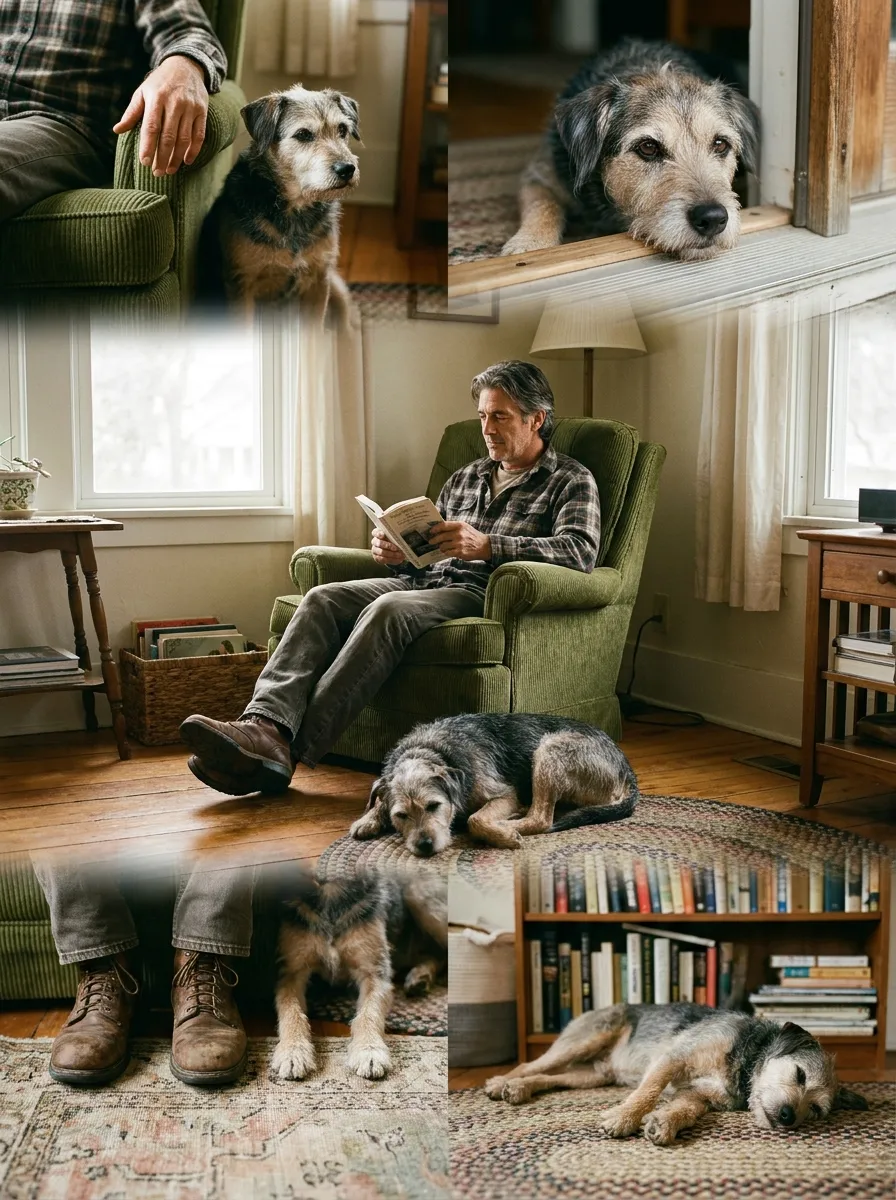
The Place They Keep Choosing in the Room
September 14, 2026 • 5 min read
A room can look completely still while a relationship continues moving inside it. Nothing needs to happen.
No greeting. No touch. No sound that seems worth remembering.
You may be reading, working, eating, watching something, or simply passing time. Somewhere else in the same room, another living being has chosen a place. Beside the sofa.
Near the doorway. Under the table. Across the room.
Close enough to remain present, far enough to remain separate. The placement can seem incidental. Perhaps sometimes it is.
But once the same kinds of distances and positions begin appearing again and again, it becomes difficult not to wonder whether space itself has quietly entered the relationship. A companion shares space. That sounds simple enough.
Sharing space can mean little more than occupying the same physical environment. Two lives can be present inside the same room without every position carrying significance. And yet companionship makes complete neutrality difficult to assume.
Not because every movement contains a hidden message. Not because every chosen corner requires interpretation.
But because relationships gradually make us aware of things we would otherwise have no reason to notice. Distance becomes one of them.
You begin recognizing what near looks like. You notice what farther away looks like. You become familiar with the places another presence tends to occupy while ordinary life continues.
Eventually, the room is no longer only furniture and empty floor. It contains patterns. The particular space beside a chair.
The stretch of floor where someone frequently settles. The doorway that allows both separation and continued presence. The place from which one life can remain inside the activity of another without directly entering it.
None of those positions tells you exactly what is being communicated. That uncertainty matters. It would be easy to turn placement into translation.
Near means this. Far means that. Following means one thing.
Remaining still means another. But a living relationship may deserve more restraint than that. Observation can recognize a pattern without claiming to possess its explanation.
You can notice that a companion repeatedly chooses a particular relation to your body in a room without pretending to know the complete reason for the choice. And perhaps that is where placement begins to resemble dialogue. Not dialogue because every position can be converted into a sentence.
Dialogue because one presence changes the spatial possibilities of the other. Once someone else is in the room, space is no longer experienced entirely alone. A few feet can matter differently.
An empty corner can become occupied. A pathway can become familiar. One chair may remain yours while the floor beside it somehow becomes part of a shared arrangement neither of you formally established.
The room begins holding a history of where two lives tend to be in relation to each other. Sometimes close. Sometimes separate.
Sometimes moving. Sometimes still. The pattern does not need words in order to continue.
Perhaps this is why physical placement is so easy to underestimate. We usually notice interaction when something crosses the space between two beings. A hand reaches.
A body approaches. A sound is made. Someone responds.
Those moments are easier to recognize because something visibly happens. But what about the distance that remains? What about the companion who does not approach any closer?
What about presence that stays several feet away but does not leave? What about choosing the same room when other rooms are available, without requiring anything further from the moment? There is no need to decide what such choices mean.
The question can remain open. Still, refusing to interpret them does not require pretending they are empty. There is a middle ground between certainty and indifference.
You can notice. The location itself may become familiar before its significance ever becomes clear. And familiarity changes the room.
After enough repetition, you may stop consciously registering where your companion has settled. The placement becomes part of the background, almost like the chair, the lamp, or the light falling across the floor. Except furniture does not choose where to be.
Another living being does. That difference complicates the stillness. A chosen position contains at least one observable fact: this is where that life is now.
Perhaps closer than before. Perhaps farther away. Perhaps exactly where you have seen them many times.
The temptation is to turn that fact into a conclusion. But companionship may be richer when the conclusion is delayed. Specific placement can remain something noticed rather than solved.
That restraint leaves room for individuality. One companion’s preferred distance does not have to become another’s. One moment of nearness does not establish a rule.
One afternoon across the room does not have to contradict yesterday beside the chair. The relationship can move through space without being forced into a fixed vocabulary. Perhaps continuous dialogue does not mean continuous explanation.
Perhaps it means something quieter: that two lives keep adjusting to the fact of each other’s presence. Rooms make those adjustments visible. They show proximity.
Separation. Return. Stillness.
Movement toward. Movement away. Remaining.
None of these has to be dramatic. Most are barely noticed while they occur. And still, over time, the arrangement of shared space can become strangely recognizable.
You know where another presence often appears without having decided to memorize it. Your own movement may already account for that presence in ways too ordinary to name. The room has gradually become a place inhabited relationally rather than merely physically.
Not every corner means something. Not every distance needs interpretation. But the possibility remains that companionship is occurring even when neither life is actively doing anything to the other.
That may be what makes shared stillness difficult to categorize. Nothing is being exchanged in the usual sense. Yet neither presence is irrelevant to the other simply because the room is quiet.
One life is here. The other is there. The distance between them exists.
And tomorrow that distance may change again. Perhaps accepting physical placement as part of continuous dialogue does not require learning how to translate it. Perhaps the more interesting question remains before translation begins.
When a companion repeatedly chooses where to be in relation to you, how much of the relationship is already taking place in the space between where you are and where they decide to remain?