When the Routine Is Over Before You Really Notice It
September 9, 2026 • 6 min read
Some routines become so familiar that they begin to feel less like moments and more like transitions. Food is prepared.
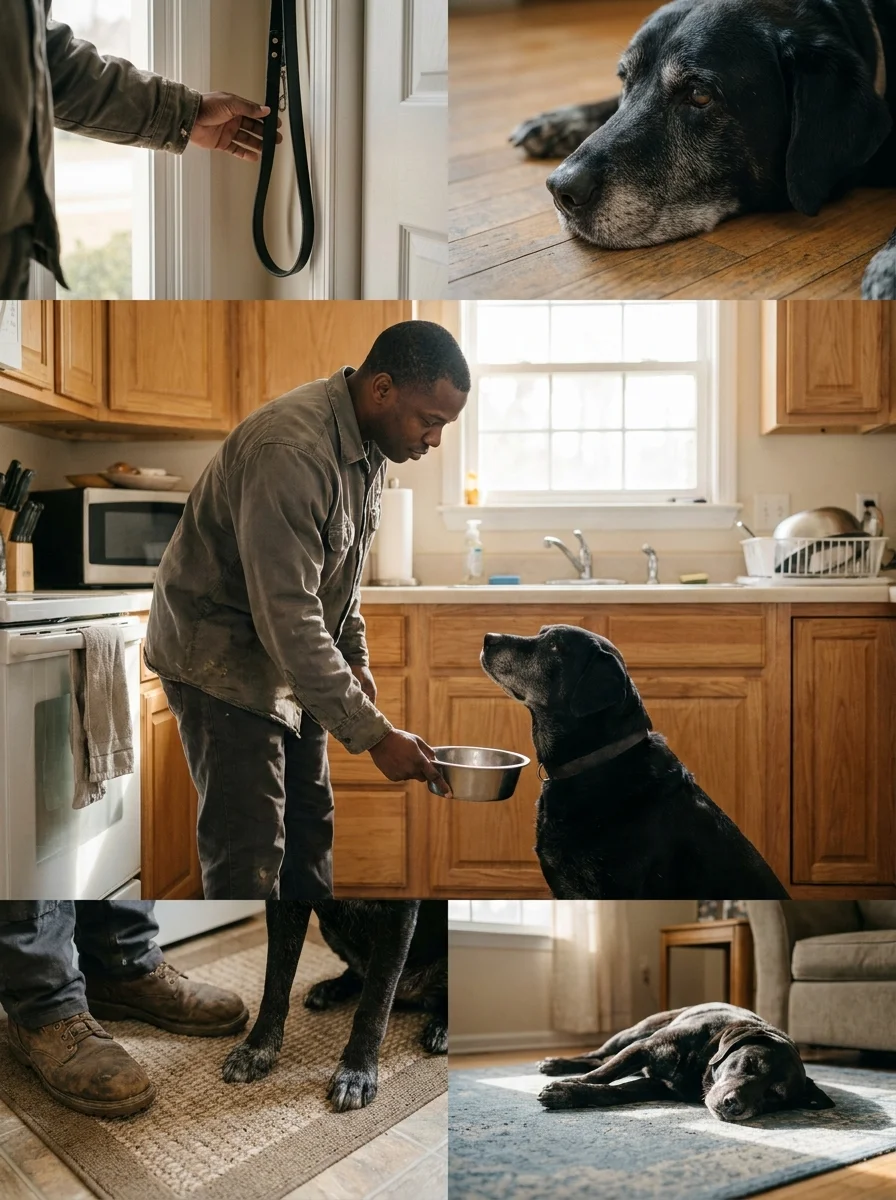
A door is opened. A leash is reached for.
A bowl is returned to its place. The familiar sequence moves forward almost by itself, and attention is already leaning toward whatever comes next. Nothing about that movement necessarily feels wrong.
Daily life contains many things that need to be done, and familiarity naturally removes some of the effort once required to do them. What once demanded thought becomes automatic. What once felt new settles into rhythm.
But shared routines are unusual. They are practical, certainly.
They also happen between two lives. That can make speed difficult to interpret.
There is a difference between moving efficiently through something and moving past something before it has quite been noticed. From inside the routine, however, those two experiences may look almost identical. The same actions still happen.
The same needs are still met. The same morning or evening continues. Only attention has changed.
Perhaps that is why hurry can be difficult to recognize inside companionship. It does not always arrive dramatically. It may simply appear as the feeling that the routine should already be finished.
One movement immediately anticipates the next. The hand reaches before the eyes have really looked.
The door opens before the pause beside it has registered. The familiar sound is heard without quite being listened to. The routine remains intact.
Presence becomes harder to locate. Because hurry can make what is present inside a routine harder to notice. That does not tell us that every routine should become slow.
It does not tell us how long a shared moment ought to last. It does not even tell us which details deserve attention. It simply introduces a tension.
The routine has a practical purpose, but the relationship occurring inside it may not be entirely practical. A morning walk can be completed. A meal can be served.
A familiar place can be prepared. A repeated need can be answered. Yet the shared life contained inside those repetitions cannot be completed in quite the same way.
There may be no clear point at which enough attention has been given. No obvious measurement for presence. No final gesture that proves the moment was fully inhabited.
That uncertainty can make efficiency especially attractive. Tasks offer endings. Relationships rarely do.
Once the bowl is down, that action is finished. Once the door is closed, that action is finished. Once the familiar routine has moved through all of its recognizable steps, the mind is free to declare that part of the day complete.
But something else may still be happening. Recognition may still be happening. Familiarity may still be happening.
Two lives may still be occupying a pattern built through countless repetitions neither side formally created. The difficulty is that ordinary routines do not announce this second layer. They look almost exactly the same whether they receive full attention or very little of it.
Perhaps that is why they are so easy to hurry through. Novelty naturally interrupts us. Familiarity often permits us to continue.
The unfamiliar asks to be noticed because we do not yet know what will happen. The familiar seems to require less from attention because its shape is already known. And yet companionship is built largely inside what has become familiar.
The same return. The same waiting.
The same sequence. The same small exchange that no longer seems remarkable enough to examine. Repetition can therefore create two opposite movements at once.
It can deepen a relationship. And it can make the evidence of that relationship easier to overlook. The more dependable a routine becomes, the less attention it may seem to require.
Perhaps this is one of the quieter tensions hidden inside shared daily life. What becomes important through repetition can also become invisible through repetition. There is no simple way to resolve that.
Trying to notice everything would create its own kind of distortion. Constant attention could turn ordinary companionship into something that feels inspected rather than lived. A relationship cannot remain natural if every gesture must become significant.
A routine does not need to be transformed into a ceremony merely because another living being shares it. The ordinary should be allowed to remain ordinary.
Still, ordinary does not necessarily mean empty. That distinction may be where the unresolved question begins.
If a familiar routine does not need to become special, what does it mean not to hurry past it? Perhaps the answer cannot be found in duration. A longer moment is not automatically a more attentive one.
Nor can it be found simply in slowness. Moving slowly can still happen without noticing anything. The tension seems to remain somewhere between pace and presence, without belonging completely to either.
You can complete a routine quickly and still be aware of the life beside you. You can move through it slowly while thinking entirely about something else. So the visible speed of the moment may tell us very little.
What changes may be less obvious. Perhaps it is the difference between seeing the routine only as something that must happen and recognizing that something is also happening within it. The first belongs to completion.
The second belongs to observation. And observation does not always require stopping. Sometimes it may exist in a fraction of attention.
The familiar movement before the bowl is reached. The pause before the doorway. The particular way presence enters a room.
The small rhythm that would probably be difficult to describe precisely because it has been repeated so many times. None of these details needs to become a lesson. They do not have to mean affection, trust, dependence, comfort, or anything else we might be tempted to place upon them.
They can remain what they are. Observed parts of shared life. That restraint matters because attention is not the same thing as interpretation.
Noticing does not require deciding. A familiar routine can be allowed to contain more than its practical function without being forced to reveal exactly what that additional meaning is. Perhaps hurry becomes interesting at precisely that point.
Not because speed is automatically careless. Not because slower living is automatically better. But because there are experiences whose value may be difficult to perceive when the mind encounters them only as things to finish.
Shared routines may be among them. They are strange containers. On the surface, they hold repetition.
Underneath, they may hold recognition accumulated through time. The movements remain small enough to disappear into the day. That may be part of their nature.
Morning follows morning. Meals follow meals. Doors open and close.
Familiar footsteps cross familiar floors. The shared sequence continues until its familiarity becomes almost complete. And perhaps there is no need to rescue those moments from ordinariness.
No need to make every routine memorable. No need to slow each one down until it feels important. But the question remains quietly inside them.
When a routine belongs not only to your schedule but also to a relationship, what disappears when the only thing you notice is that it has been completed?